PART TWO: Here is Grangetown history covering the Second World War and a little beyond. There is also now a PART FOUR, a section looking at sport, transport, local life and entertainment. We hope to add more features and would welcome any stories, articles, memories or photographs. Please email us. Return to Part One or go to Part Three
Thanks to Jack and Ken Payne, Bob Jones, Zena Mabbs, Ken Harris, Tony Hicks, Peter Ranson, Rita Spinola, Dennis Courtney, Graham Ayres, Dai's son, John Williams, Ken Lloyd and the Grangetown Local History Society for their help.
| JANUARY 2 1941 - A DARK DAY OF WAR
Let's start with the blackest day in
Grangetown history. It came in the Second World War on 2 January 1941, when
an air-raid during the full moon caused widespread casualties across Cardiff.
It started at teatime - 6.37pm. Around 100 German planes were involved and
Grangetown was the first and worst area to be hit. The 10-hour raid was
said by the Nazis to be in retaliation to the RAF's bombing of Bremen.
Hollyman Brothers Bakery, on the corner of Corporation Road and Stockland
Street, saw its large cellar used as a bunker for local people. But the
premises took a direct hit by a landmine and 32 people in the shelter
were killed. The bomb, which ended up in the cellar floor, exploded and
left an 8ft pile of rubble.
The Hollyman baking family were well established. The family business
had started with Charles Hollyman - son of a Somerset one-time butcher
and publican - in Bute Street in the 1870s, with four of his sons at various
times becoming bakers. His younger brother Robert was also a baker with
his own business in Roath. His eldest son Alfred John Hollyman, after
a short time in Roath, opened a bakery in Corporation Road by the late
1890s. By 1941, Alfred, was 74, a widower, and he lived above the shop
in Corporation Road with one of his daughters, Ethel, 43. The bakery itself
was in separate building in the yard, along with a stable for one of the
bakery's two delivery horses by the lane in Stockland Street. The business
was run by eldest son Bill, 38, who lived with his wife Margaret, 36,
and their 12-year-old daughter Joan in a house next door at the end of
Stockland Street. The bakers would call in passers-by and neighbours to
use the Hollymans' shelter in the cellar during air raids. That night
it was packed, including Alfred, Ethel, and Bill and his wife and daughter.
All were killed. Alfred's brother Bill, 72, another baker, survived, as
he was apparently sheltering elsewhere, while his son Jack, 40, who eventually
re-started the business, was living in Lansdowne Avenue, Canton. Others
known to have died in the shelter included Elizabeth Williams, 56, and
Thomas Williams, 68, both from Stockland Street; Philip and Lilian Morgan;
and Magdalene Maude Wells, 51, from Llanbradach Street.
It was thought the remains of those who perished were buried on the site,
but descendants later discovered two Hollymans were buried in a city cemetery.
Around 20 unknown victims were also buried at the spot. Many could have
been children, as Alfred was heard to be calling children into the shelter
after the air-raid siren was heard.
There were at least another 30 casualties in Grangetown that night,
during 10 hours of bombing, until the all-clear sirens sounded after 4.50am
on 3 January.
They included nine people in nearby Clydach Street, including
Thomas and Caroline Lyons , 56 and 48,and their 14-year-old son John at
No 8. Next door at No 10, David and Emma Jones, both in their 80s, were
killed along with their three daughters Blanche, Annie and Emily, aged
between 47 and 50.
There were also a number of homes destroyed in Jubilee Street in
Saltmead - with Thomas and Nellie Nicholls, their 20-year-old daughter
Muriel and a four-year-old boy, Neil Chiaramonti, killed at No 66 - he
was an only child and his mother a widow, according to the funeral notice
a few days later. Three blocks of maisonettes were later built in the
place of the damaged houses.
According to the school records from the time, as well as damage to
Jubilee Street from a land mine, Compton Street, Stafford Road, Allerton
Street, Monmouth Street and Court Road also sustained heavy
damage. A bomb fell in Maitland Place demolishing part of Saltmead
Hall. Court Road School was also closed due to the extensive damage. Three
were killed in the air raid in Bromsgrove Street, while the Grangetown
National School was forced to close, because of an unexploded bomb 20
yards away. All families from St Fagans Street, Knole Street and Worcester
Street were evacuated.
Seven more were killed at the corner of Ferry Road and Holmesdale
Street, including brothers Ivor and William Dix - both married men,
one 29 and the other 34. James Griffiths, a special sergeant, who lived
in Cambridge Street had gone into one of the homes demolished by a bomb
and brought out the body of a dead boy and an injured girl, crying for
her mother. The girl died within hours and it was months before the body
of her mother was found deep in the rubble. Sgt Griffiths, who also spent
three days helping to dig at the wreckage of the Hollyman's shelter, was
called to deal with many incendiary bombs in the Grangetown and Docks
areas. He was awarded a BEM by King George later that year. His widow
Elizabeth recalled 40 years later that the experience of civilian casualties
for this Great War veteran took its toll and he died in 1952. "All he
did was wander around in a daze," she recalled of the aftermath.
Others were killed in Paget Street, Penhaved Street, Pentrebane Street
and the Taff Embankment, or were killed when bombs dropped while
they were in Canton, Riverside and Docks. Locals recalled being kept inside
the Ninian cinema, which was showing an Abbott and Costello film and not
emerging until it was safe at 2am, but seeing the blazing remains of the
bakery as they returned home.
The death toll across the city that night saw an estimated 165 dead,
427 hurt and nearly 350 homes destroyed or had to be demolished. Hundreds
were put up in 20 feeding and rest centres in church halls and corporation
buildings, including City Hall, which only a few days earlier had hosted
a New Year's Eve dinner. Grangetown's gas works had been hit, cutting
off supplies across the town for several days. Chapels and Llandaff Cathderal
were also damaged, with the Dean and verger injured fighting the fire,
which destroyed the south roof of the nave, the west window and the organ.
Riverside, neighbouring to Grangetown, also suffered when a landmine
dropped on De Burgh Street, killing 50, while you can see a plaque on
the rebuilt Conservative club in Neville Street and the newer houses which
now stand on the spot were properties were demolished. Seven relations
who had been to a family funeral earlier in the day were killed in Blackstone
Street, with the homes there so badly damaged the street was never rebuilt.
Due to censorship and reporting restrictions, there were scant details
in the Western Mail of the day beyond the headlines - Cardiff wasn't
even named in the next day's edition as the "South Wales coast town,
which underwent an intense fire blitz." What they weren't able to
print in terms of names and places, they made up for in description. "A
thick smoke haze hung over the town and through the haze loomed the silhouettes
of tramcars and buses at the roadsides." There was a bit more detail in
the Echo in the days to come. Only a few families posted notices to the dead. There
was a communal funeral for 30 at the Cardiff Cemetery, attended by hundreds
and the Lord Mayor, and more private burials elsewhere. There was an appeal
for more blood donors for the infirmary.
But life also went on. They had A Night Train to Munich on at
the Ninian cinema in Penarth Road, while in town Humpty Dumpty
was the pantomime at the New Theatre, which held early performances to
"beat the blackout". And in the week that followed both Rex
Harrison and a young Lawrence Olivier were appearing in plays at the Prince
Of Wales and Park Hall theatres.
Across Cardiff, more than 2,100 bombs fell between June 1940 - the first
raid was at 12.55am - and March 1944; altogether, the death toll in air
raids was 355, with more than 500 injured.
Hollymans continued as a bakery until the early 1950s, when a hardware
shop was set up there. There is a plaque to those who died at the bakery
site, erected by Grangetown Local History Society on the wall of Clarence
Hardware's shop, which is still doing business.
|
'I left for work as usual, unaware of the tragedy that had happened'
JOHN WILLIAMS, who was the bread delivery
boy at Hollymans, tells his story.:
My road was Corporation Road, into Coedcae Street, Taff Embankment, across
Penarth Road bridge, into Percy Street, Harpur Street, back into Penarth Road,
up the hill the left into St Mary Street, across the junction of Wood Street
and into High Street delivering long loaves to the Bungalow Cafe on the right
hand side. Then Castle Street through the Hayes into Bute Road, left into Tyndall
Street. Turn around, then left into Bute Street proper, into Mount Stuart Square
where one of our customers lived in the top flat of a building, so I had to
take the lift up to deliver her loaf. From there into James Street. It never
happened every day but some days I had to wait for the swing bridge to open
and shut to let the Bowles sand dredger leave her berth to go out into the local
channel to do her dredging. This operation took at least a quarter of an hour
to complete. We had a couple of customers in Hunter Street and Pomeroy Street,
back over the iron Clarence Road Bridge, which was a hazard with a four-wheel
van because of the tram lines. Then into Ferry Road, into Kent Street, Holmesdale
Street, Grange Gardens and back into Corporation Road.
I remember a rather funny incident where I was seeing to a customer in Corporation
Road with the horse stationery in the gutter, when there was a very loud noise
coming from our rear. The horse shot off and galloped back to our bakery. Luckily,
someone caught him. There was me running after him. The noise was an American
tank trundling down Corporation Road. We had a good laugh at the time, but it
was serious really.
The round I have just described was just one of three I had altogether. It
was hard work for a young man like myself in all weathers; in summer and winter,
in wartime. They talk about "pressure" today, but they don't know what they're
talking about.
I saw a smoking ruin of a three-storey house and shop, with bodies wrapped
up on stretchers being removed. There was a thick layer of ice in patches over
the ruins. It had been a freezing night and morning. The horse in the stable
was all right, only yards away. As far as I can remember, Mr Jack Hollyman was
there - he lived with his wife in Lansdowne Avenue East in Canton. He told me
to go home and he would carry on the business in a few weeks time and would
call me later.
About six weeks later, we were back on rounds and I worked in the bakery with
the old baker Charlie, who lived in Channel View Road. Jack Hollyman and I stayed
there until I was called up into the army on 17th August 1944.
Ken Lloyd (pictured above left) was another who remembers the raid.
Aged 12 and a half at the time, he was on his way home from a children's meeting
at the Ebenezer Chapel in Corporation Road, when he was among those called towards
the shelter by Mr Hollyman. "I was just walking past Grange Gardens, coming
home. I lived in Warwick Street and told him I didn't have far to go," said
Ken, as he too recalls how fate intervened. Of the children he said, "We
were with them one day, and they next day they weren't there. Everyone who had
gone in there (the shelter) was killed outright."
See also Cardiff Blitz - pictures (BBC Wales/Glamorgan Archive), Cardiff's worst night of the Blitz and Video - Cardiff remembers 1941 Blitz
 In 1939, I was 13 and still in Court
Road School. At 14, I started to work at Hollyman The Bakers, who had their
premises at Corporation Road on the corner of Stockland Street, where the bakery
was and in the yard. Joining was the stable that had one berth for horses. The
family had two, one was in a field in Penarth Road. I started at 8am delivering
bread in a four-wheeled covered van. Bill Hollyman showed me how to assemble
all the trappings of the harness beforehand. Then in a matter of months, I was
grooming, feeding and doing this job myself.
In 1939, I was 13 and still in Court
Road School. At 14, I started to work at Hollyman The Bakers, who had their
premises at Corporation Road on the corner of Stockland Street, where the bakery
was and in the yard. Joining was the stable that had one berth for horses. The
family had two, one was in a field in Penarth Road. I started at 8am delivering
bread in a four-wheeled covered van. Bill Hollyman showed me how to assemble
all the trappings of the harness beforehand. Then in a matter of months, I was
grooming, feeding and doing this job myself.
 I call it "fate" but the night of the bombing of 2nd January 1941, when most
of the Hollyman family lost their lives and many more people as well. The night
before, I was actually down that shelter after my round was finished and I had
bedded down the horse, Dolly. I was invited into the house and had a bowl of
lovely hot soup before going home. The next night, after completing my round,
Bill Hollyman said to me "I think you had better go straight home because your
mother and father will be worried about you." So I left, and spent the night
with my family - my parents, brother and sister - in an Anderson shelter out
our back in Devon Street. It was night of bombing and indendiary bombs. The
noise was incessant. It was a long night and I cannot remember whether we had
any sleep that night. Well, the next morning (January 3rd), I left for work
as usual, unaware of the tragedy that had happened until I turned the corner
of Stockland Street.
I call it "fate" but the night of the bombing of 2nd January 1941, when most
of the Hollyman family lost their lives and many more people as well. The night
before, I was actually down that shelter after my round was finished and I had
bedded down the horse, Dolly. I was invited into the house and had a bowl of
lovely hot soup before going home. The next night, after completing my round,
Bill Hollyman said to me "I think you had better go straight home because your
mother and father will be worried about you." So I left, and spent the night
with my family - my parents, brother and sister - in an Anderson shelter out
our back in Devon Street. It was night of bombing and indendiary bombs. The
noise was incessant. It was a long night and I cannot remember whether we had
any sleep that night. Well, the next morning (January 3rd), I left for work
as usual, unaware of the tragedy that had happened until I turned the corner
of Stockland Street.
The hole in the roof after the air raid
By Dai's son We had an Anderson shelter in out garden but as we hadn't been having
any air raids my Dad had been keeping some live ducks in ours. My mother my
two sisters my younger brother and myself joined our next door neighbours the
Alloways in their shelter. There were Mrs Alloway,Sylvia,Dorothy,Pamela, Valerie
and Lilian, eleven persons in all squeezed in a shelter about 8ftx6ft. The two
Dads were out on firewatch duty, my Dad using a metal dustbin lid in place of
a helmet. That night it was a very heavy raid, anti aircraft guns blasting off
including one on the railway line just across the road. High explosive bombs,
land mines and hundreds of incendiary bombs rained down on Grangetown. A high
explosive bomb fell on the Mansion House at the corner of Ferry Road and Holmesdale
Street killing a number of people. A parachute land mine fell in the barrage
balloon field at the end of South Clive Street partially destroying the last
six houses in the street and damaging a number of others but not causing any
injuries. We emerged from the air raid shelter at about 7am sometime after the
all clear wondering if our houses had been damaged. Surprisingly everything
seemed to be in order. Two houses across the road had been hit by incendiaries
but they had been extinguished with sand before causing much damage, and our
house with exception of having some front windows broken and a large piece of
shrapnel embedded in the wooden window frame all seemed in order. I later noticed
that there was a neat hole in the slate roof at the back of the house. The hole
was about three to four inches in diameter and looked as if it had been cut cleanly
with a knife or pair of scissors. We speculated as what could have caused this
hole and it was decided that I should climb into the roof void to have a look.
My mother or father could not have got through the trap door. I was eight years
of age and told to listen out for any ticking sounds and to look for anything
strange but not to touch it. We didn't possess a torch in the family so I was
given a box of matches. When I got into the roof void I had to balance on the
beams and try not to fall through the ceiling whilst striking a match. I could
see daylight through the hole in the slates but this did not give much light
neither did the matches. I listened but could not hear any ticking noises and
couldn't find anything near the hole. It is probable that whatever came through
the roof that night entered with great speed hit a rafter and ricochet to a
far corner. I didn't think of that at the time. When I got out of the void and
told my mother that I couldn't find anything it was decided that as it wasn't
ticking and provided the thing was not touched it would do no harm to leave
it be and that is what happened.
A week or so later workmen came removed the bottom slate and slid another
in its place but the hole in the top slate was still clearly visible. When I
left South Clive St at the age of 18 to join the RAF the holed slate was still
visible and by that time the object was forgotten and still not found. In 2010
I returned to South Clive St, and was told the whole roof had been completely
reslated a few years before. So it still remains a mystery as to what caused
the hole and is it still there?
Our family moved to 81 South Clive Sreet
in 1938, a semi detached house. With a small trap door giving access to the
roof void just above the stair landing. At about 8.45pm European time on Thursday
2nd January 1941 a squadron of German bombers set of in a northerly direction
from their newly captured airfield in northern France. They started to cross
the English channel at Cherbourg and entered England at just about Weymouth
on a cold clear moonlit night. They continued north until they reached the Bristol
Channel at Bridgewater Bay and there below them lit up by the moon shining like
a well lit motor way was a ribbon of water leading to the heart of England and
Wales. The pathfinder aircraft new that if he followed this water way until
he observed a large river on his right with an equally large river to his left,
on his right hand side was Bristol, and on his left Cardiff. That night their
target was to the left. At about 9pm B.M.T. the air raid warnings sounded at
Cardiff.
Highly recommended, including
for his memories of a Grangetown childhood, is the autobiography of Labour MP
Paul Flynn. The Unusual Suspect
(Biteback, £19.99) includes stories of growing up in the early 1940s and
the impact of war. Mr Flynn, who was brought up in Penarth Road, describes schooldays
at St Patrick's, wartime air raids and sometimes the stigma of being poor -
"the context against which I judged my social security job in Parliament 50
years later was the painful, proud and honesty poverty of working-class life
in Grangetown." There are moving stories, not least of his father, who was injured
in the Great War and only survived thanks to the kindness of his German captor;
and the strong will of his widowed mother who resisted the call of the local
Catholic priest for him and his brother to be taken in by an orphanage. The
Flynns were in a Grangetown which was a "melting pot of confused identity,"
and Mr Flynn from his own Irish-Catholic ancestry writes passionately of his
own discovery and love for the mother tongue of Wales.
Speaking to the ITV Wales Face To Face programme, Mr Flynn recalled
the "dirt poverty" with his widowed mother bringing up a family of four. "My
father died when I was five and my mother had virtually no income. It was dirt
poverty, the like you don't expect to see today except perhaps in third world
countries. We lived entirely on charity, there was no income coming in. I remember
the stigma of wearing a suit made out of a cloth which was free. A lot of pupils
in Grangetown at St Pat's were poor, but there was a group of us who were dirt
poor and we were stigmatised wearing these clothes, which said we were poor."
|
Bombing of the San Felipe by Jack Payne
It was a sunny afternoon - July 9th
1940. There were many people about in their gardens and in the street when
our attention was drawn to the drone of an aeroplane getting louder and
louder. I then saw a twin engine aeroplane flying along South Clive Street.
It was so low that it was almost touching the chimney pots of the houses.
I cannot recall seeing any markings on the aircraft but the engine sound
was similar to that of German aircraft, a rhumba rhumba beat. Mrs O’Connor
who lived opposite said she did see German markings on the plane. The plane
continued to the end of South Clive Street and then turned left and flew
towards Cardiff Docks. It didn’t seem to be flying very fast. When the plane
came over the Docks it banked and I could see little black dots falling
from it. The black dots seemed as if they floated down rather than drop
quickly. There followed a muffled sound of explosions and someone shouted
its dropping bombs and everyone ran for their shelters.
That evening my father who worked at Cardiff Docks came home and told
us that a ship - a British steamer - called the San Felipe had been bombed
in the docks and a number of men had been killed. The men included
Jeremiah Savage, who lived in Cornwall Street.
MISERY AND EXCITEMENT - THE WAR AS A GRANGETOWN BOY By
Dai's son Misery I will start off with the
misery because it is always better to finish a story on a happy note.
I was six when the war started a pupil at The Nash in Clive Street, Grangetown.
Not that that was particularly miserable. When the war started we were
all issued with a rubber gas mask contained in a light brown cardboard
box. There was a length of string going from one side of the box to the
other so that the gas mask could be carried over your shoulder. We had
to take the gas mask to school. If we had enough bread in the house, which
wasn't often, there was enough room in the top of the box to put a fish
paste sandwich. Each day in school we had gas mask practice. This meant
at a command from the teacher who would then start counting we would take
the gas mask from the box and pull it over our face. I can still remember
the strong smell of that rubber. We were supposed to have the gas masks
on before the teacher reached ten, with the teacher calling out don't
hold your breath make sure you breath. If you hadn't fitted the gas mask
properly as soon as you took a deep breath the sides of the gas mask contracted
and you couldn't breath at all this meant that many children would tear
the mask off much to the frustration of the teacher. Eventually when all
gas masks were properly fitted we had a session of walking around the
classroom in file. The viewing panel of the gas masks easily steamed up
with children unable to see where they were going. Bumping in to each
other and tripping over desks. The problem was eventually overcome by
rubbing soap on the inside of the panel. We were all issued with a small
piece of coloured ribbon, red green or blue and a safety pin. This piece
of ribbon had to be worn on the chest every day as it depicted where you
would have to go in the event of an air raid. Some children being allowed
to go home, some being collected by parents and others shepherded to a
meeting point and taken to a communal air raid shelter. I cannot remember
what colour I had but I legged it for home as soon as the siren went.
My mother couldn't collect me because she was working in White Wilson's
Factory situated on the corner of South Clive Street with Ferry Road.
Prior to the war this was a furniture factory now changed to making ammunition
boxes and the like. During the air raids some of the children in my class
were killed and we had periods of silence to remember them. I remember
the teachers were upset but I cannot remember how I felt about it at the
time.
I was taken by my mother to see the devastation at Tresillian Terrace
where a whole rank of houses were destroyed, I also went to Corporation
Road and saw where some people had been killed at Hollymans Bakery, and
of course the Mansion House opposite the Plymouth pub where the Noble
family and some men sheltering from the blitz were killed. One of the
things I remember most about these blitz sites was that in nearly every
house that was destroyed the stairs were still intact. It was probably
for this reason that in the early days of the war before we were issued
with an Anderson shelter we always took refuge in the pantry under the
stairs when an air raid began. When the Mansion House on the corner of
Ferry Road and Holmesdale Street had a direct hit and was completely destroyed
I had to pass this site the following morning on my way to school. The
road was covered with debris, people were digging amongst the ruins looking
for survivors or bodies. The road was also covered with hosepipes like
a lot of spaghetti. On arriving at school I was sent back home again.
The early winters of the war were very cold with much snow and sleet.
Most of the people of Grangetown had started the war with very little
having just come out of the depression. Now they had even less. Food rationing
was a problem for parents, "Dig for Victory" was a slogan well-publicised.
This meant we started to grow our own vegetables. This also meant every
time a horse came along our street I was sent out with a bucket and shovel
to try and beat other boys in a race to collecting the manure. We made
up for the lack of sweets by purchasing Nippits, zubes and liquorice root
from the chemist. I can only suppose that as a result of the food rationing
and shortage of fruit we were not getting enough vitamins so I and many
other children suffered from boils and abscesses. We would have these
on our necks, arms, legs and bottoms. The boils and abscesses were sore
enough but the treatment was even worse. A poultice either of the purchased
type, like sticky putty or one made from bread was smeared on a bandage
or piece of rag immersed in boiling water and then whilst it was still
red hot slapped onto the boil. This was meant to bring the boil to a head
so that it could be squeezed and burst. It was absolute agony!
The schools and our houses had only one form of heating - a coal fire.
Fuel for fires became almost impossible to get. Coal merchants stopped
street deliveries. I remember bitter cold days being sent out with holes
in my shoes just covered with a piece of paper or cardboard, with a pram
or a sled when snow was on the ground to different coal merchants to try
to buy coal or coke. I wasn't very successful. Every book in our house
was eventually used as fuel. Besides heating the house the coal fire was
also the only means of heating the hot water system. Consequently there
was very little hot water. This meant we didn't wash very thoroughly or
often and tide marks around a child's face was commonplace. Needless to
say our hair wasn't washed very often either and flea-infested hair was
almost the norm. The "Nit" nurse visited the school every week and all
children had their hair combed with a steel nit comb which besides collecting
the fleas and nits left deep furrows across ones scalp. We were sent home
with a note advising or parents on methods of delousing our hair. There
was at least one occasion as well when a mobile shower unit arrived at
the school with the children ordered to take a shower.
About the end of 1940 our family was issued with an Anderson shelter
which we erected half submerged in our back garden. When the air raids
were at their height we didn't go to bed in our house but went straight
to the air raid shelter. The shelter was about six feet long and four
feet wide with two bunk beds either side. Lighting inside was from candles
and the walls of the shelter ran with condensation, so much so that in
the morning the floor of the shelter had 1/4 to 1/2 an inch of water on
it. The shelter was cold, wet, with no form of heating and I think if
the air raids had continued for much longer we would have stood more chance
of dying from pneumonia than from a bomb. The authorities later issued
us with bags of broken cork and told Dad to paint the walls of the shelter
and throw the cork onto the wet paint. This was meant to absorb the water
but it didn't work. Those first few years of the war were miserable as
regards to food and warmth but all was not bad.
Excitement. For a boy of about my age at the time there certainly
was excitement. Despite the fact that there had been deaths and serious
casualties amongst people we knew I do not think any of us believed that
we would be killed or injured. At night after we had retired to the air
raid shelter if the air raid siren went my father had to report for "fire
watch" duty. He would leave carrying a metal ash-bin lid over his head
as a helmet. Only the head fire warden Mr Norris had a steel helmet.
I along with other boys had learned to distinguish the sound of a German
aircraft from a British one. My mother allowed me to stand between the
blast wall and the entrance to the shelter to report on the progress of
the raid. Searchlights probing the night sky like giant illuminated fingers
could be seen almost as far away as Newport, Swansea and Bristol. Because
of the blackout there was no ambient light so the illumination was more
intense. It became exciting as the planes drew nearer if a searchlight
picked one out. From the resulting fires from bombs and incendiaries I
could keep the family informed of the area being attacked. When the raid
came nearer to home I had to get into the shelter because of the danger
from shrapnel. The following morning despite warnings from parents not
to pick up strange articles the boys would race from their homes to search
for remnants of the air raid. All the boys and some girls collected shrapnel
and swapsies would take place in school! The larger the piece of shrapnel
the more prized it became. Other objects were also sought after. An incendiary
bomb burned leaving a small pile of white powder and the metal fin intact.
Occasionally one, which had fallen in the street, didn't burn out entirely
so part of the bomb would still be attached to the fin. These were collectable.
Shell-nose caps still showing the height calibration settings and pieces
of the parachute from a parachute bomb were all sought after. Occasionally
used aircraft cannon shells could be found after a dogfight.
Ron Ayres who lived in Channel View found a live round and tried to
remove the shell from the casing, The shell exploded and he was almost
killed. He missed a year's schooling.
Ron's brother Graham writes in 2008: "Ron's injuries were to his
chest, I was also injured - we survived. Ron will be 77 and me 72 this
year."
The Rover, Hotspur
and Wizard boys paperbacks all carried stories of German troops landing
from submarines or being shot down, giving up and being captured by civilians
and groups of boys. I suppose it was a type of propaganda. Nevertheless
our gang set about digging trenches near the tide fields where we could
keep watch and storing there home made bows and arrows and wooden spears
in preparation for any would be invaders. The most exciting and dangerous
escapade was yet to come. One must know that prior to the war starting
except for the No7 or 12 bus and the coke fired lorries of the Gas Works
there was virtually no motorised traffic in Grangetown. This being so,
hardly any children had travelled on a motor vehicle other than a bus.
Once the war started lorries began to appear travelling to and from the
barrage balloon site and the ordnance depot and most of all the slow moving
convoy of Smoke lorries, which travelled daily from the Docks to Llandough,
and Leckwith woods. One day one of the boys, most probably Dobbin Seward,
came to school and said he had had a ride on a lorry from Ferry Road to
Penarth Road. He said he had been standing at the corner of Ferry Road
with Clive Street, when a lorry stopped. He jumped up and grabbed hold of the
tail board and hung on until the lorry stopped at the junction with Penarth
Road. This was an opportunity to good to miss. The boys gathered at the
Ferry Road, Clive Street junction. About 4.45pm along came the convoy
travelling at about 15mph. As the lorries reached the junction one or
two boys jumped on the back of each lorry and hung onto the tailboard.
All the drivers were sounding their horns to warn the one in front of
the boys hanging onto their lorries it was bedlam. The success of this
made us look for more and faster vehicles with the practice spreading
throughout Grangetown and possible further a field. Occasionally lorry
drivers would stop and get out and chase the boys but we were too fleet
of foot to get caught. It was a practice, which continued for about a
year but faded out as the volume of traffic increased making it too dangerous.
The final excitement was yet to come. After the Americans entered the
war they put up a compound on the Marl where they stored the wooden crates
that had been used to contain Jeeps and other vehicles that had been brought
across the Atlantic on ships.
Hundreds of these crates were stored there but as the end of the war
approached the guards allowed people into the compound. The crates were
taken and a huge bonfire was erected on the Marl. Effigies of Hitler and
Goering were placed on top.
On V.E. Day hundreds of people went onto the Marl when the bonfire was
set alight. I then went to Grangetown Square where again there were hundreds
of people singing and dancing in the street. Everyone was hugging and
kissing each other. The excitement was intense it must have been the biggest
party ever held in Grangetown.
SCHOOLDAYS IN THE LATE 1940s
Dennis Courtney, now living in south
Australia, sends this photo (left): "It would be in the late 1940s
- Mr Whickham's class at the Grangetown Council School. Most of the boys
would be in their late 60s or early 70s now. The building in the background
is the two classrooms they built in the school yard. They used to be Mr
Stuckey's and Mr Thomas's.
Not long after, Graham Ayres sent us this photo of the school's
baseball team (right), with trophies, in Grange Gardens in 1949.
He's back row, fourth from the left. Click on the photos for larger
versions - let us know if you're in the photos and have any memories!
|
 JULY
6th 1944 - PILOT'S ACTIONS SPARED VILLAGE JULY
6th 1944 - PILOT'S ACTIONS SPARED VILLAGE
The final actions of a pilot, from
Grangetown in Cardiff are not forgotten by a Nottinghamshire village.
Pilot Officer Reg Parfitt, 22, and six fellow crewmen were killed when
their damaged Halifax bomber crashed returning from a mission over northern
France on 6th July 1944. But P/O Parfitt managed to prevent the plane
from coming down in the village of Farnsfield, sparing a further loss
of life.
In 1994 - 50 years after the tragedy - the village erected a memorial
to the men, all in their early 20s, which was marked with a fly-past.
They have also named a road Parfitt Drive.
Reg was the son of Arthur Ernest Parfitt and wife Sarah, who for many
years ran a chip shop at the top of Clive Street and the family were prominent
members of Clive Street baptist church. He is pictured left while on leave
back in Clive Street.
The Halifax MZ519 was built as a night bomber at high altitude and had
been on a raid on V1 flying bomb sites. P/O Parfitt had earlier flown
a day-time mission, as part of Number 578 Squadron, but set out again at 7pm. On its return from a successful
raid it was thought to have been hit by anti-aircraft fire somewhere near
Dieppe. The damaged and burning plane headed back towards its Yorkshire
base at RAF Burn and reached as far as Farnsfield near Mansfield, where
the wing fell off and it crashed in trees at 10.25pm.
He was said to be a "serious and determined young man" who had been promoted
from Sergeant-Pilot to Pilot Officer only the day before he was killed.
This was his 24th bombing mission.
Thanks to Ken Harris in Canada for the details and permission to use
the photos
There are more details on the excellent Halifax
Bomber Memorial webpage, which aims to keep up a virtual memorial, while local people maintain the memorial at the site of the crash.
NOVEMBER 3rd 1943 - ENGINEER HELPS BRING STRICKEN BOMBER HOME
An RAF engineer from Amherst Street, Grangetown was honoured both by
Buckingham Palace and his old school following an act of gallantry while
flying on a bombing mission.
Sgt Jim Norris, 23, was an engineer on board a Lancaster, which was
badly damaged over the Netherlands by two German fighters in November
1943. Two of the crew were killed but the Scottish pilot Flt Lt William
Reid, 21, and Flt Sgt Norris, both injured and in a seriously damaged
aircraft, carried on with their mission over Dussedorf. The course was
plotted using the moon and stars for nearly an hour. On the return, the
pilot became semi-concious and Sgt Norris, who had an injured arm, had
to stand up and take control of the aircraft as it crossed the Channel
with the pilot slumped in his seat. Flt Sgt Norris gave Flt Lt Reid oxygen
and Flt Lt Reid eventually recovered enough, and despite having no navigation
equipment left, a smashed windscreen and no undercarriage, landed the
plane on its belly at an airbase in Norfolk. Pupils at Grangetown Boys
School were given an afternoon off to mark Sgt Norris' heroics, while
he was presented with a framed photograph of himself, which he donated
back to the school. He received the Conspicuous Gallantry medal for his
actions in 1944, while Reid was awarded the Victoria Cross. Jim Norris
ran a shop in Mardy Street after the war with his wife Lilly and died
in 2009, aged 88. The late Reid's VC medal was sold for a record £384,000,
in the month of his former colleague's death.
|
| "GOING OVER THE BORDER" - THE GRANGETOWN TO PENARTH SUBWAY
By Jack Payne
I believe it was in the 1920s that the subway was built underneath the river Ely connecting Grangetown with Penarth Docks. I think it was made to enable dockworkers from Cardiff to access the newly formed Penarth Docks.
Prior to the war our family often frequented the area beyond South Clive Street
leading to the subway because for some time my mother Peggy was the pianist
who played in the Red House pub. Whilst my mother and father, (who played
drums) were in the pub I with my brother and sister played on the slipway
behind the pub.
During the war access to this area was denied to all who but those working
in the area and Special Constable Sid Radford, who had a shop in Paget
Street, was posted there along with one other to police the access. When
the war finished this area along with the subway was opened for public
access. The subway was used as a quick route around the rocky coastline
to Penarth beach and pier. Initially there was some person on guard at
each end of the tunnel, which sloped very steeply from the Grangetown
end to an "S" bend at the bottom and a more gradual rise to the Penarth
side. There was a naked 60-watt light bulb in the roof about every twenty
yards. The ceiling and walls were always dripping with water and when
it was first opened after the war there were plenty of stalactites and
stalagmites. The guards were there ostensibly to stop persons riding their
bicycles through the tunnel. After a few months the guards at the entrances
were removed and youths using the subway took out the light bulbs and
threw them to the bottom causing a loud explosion. For a while the authorities
replaced the light bulbs but as they were continually getting smashed
they eventually gave up. This plunged to tunnel into complete darkness
and at the bottom one could not see their hand in front of their face.
As there was nobody to stop them persons began riding their bicycles through
the subway and as they had entered in daylight they had no lights. Consequently
anyone walking in the subway had to keep a sharp ear for the sound of
swishing tyres as the bicycles would be travelling at a fast speed. Running
along the side and full length of the subway was a large pipe about a
foot in diameter. If one heard a bicycle coming, jumping onto this pipe
was the only safe refuge.
Sundays in Cardiff in the late 1940s were dead as the proverbial Dodo.
Shops, cinemas and pubs were all closed. The only places open were churches
and other places of worship. Then the Marina concert hall on Penarth Pier
opened with live talent contests for singers, comedians and musicians.
When the tide was right, you could walk around Penarth headland from
the subway to the pier. This meant there was a steady flow of teenagers
using this route on a Sunday evening. the term used by the teenagers was
"Going over the border". When the tide was up the train from Grangetown
Halt was used.
Jack's younger brother KEN PAYNE adds his memories of the Subway
from the 1950s: "This in essence was a metal tube under the River
Ely, very often it was in complete darkness.We would venture through the
darkness untill we could see the little halo of light appear telling us
we were nearing Penarth Dock.Once up in the dock you could cross the dock
gates and walk down to the pebble beach. Penarth dock had several World
War Two ships that had been mothballed which carried a great deal of interest
to us.The little pebble beach at Penarth was quite popular on nice summer
evenings. There would be lots of people taking a dip here. One of the
things that I found intriguing then were the metal stairs that used to
wind down from the cliff top,only to come to an end halfway down where
they’d fallen into disrepair. These stairs must have been a hair raising
experience even whilst in good order.When it was quiet we would pass our
time hurling rocks at the cliff face to try and bring it down, we would
be delighted at any small rock fall."
"We would also spend our time roaming around the dock looking for
scrap metal. This would consist of old nuts and bolts, off-cuts of metal
plate and any metal object we could carry. Once we thought there was a
sufficient weight it would be a case of lugging the metal back through
the subway. Then it was down to Bill Ways' scrapyard to see what we could
get. Generally we would be given a half crown or two bob - a pretty miserly
return for half a day dragging metal from Penarth to Cardiff, but we were
happy."
Under the river - the Grangetown subway
ZENA MABBS looks at the Grangetown subway, which ran under the River
Ely from late Victorian times. It's still there of course, if closed off.
Work began on the subway in 1897 using a trench and cover technique
from the Ferry Road, Grangetown end under the river at the same point
as the ferry crossing. The lowest section of the tunnel lies 11 feet
below the river. The decision to construct the Ely River Subway was
made by the chairman of the Taff Vale Railway, Arthur E. Guest. George
T. Sibbering, chief engineer of the Taff Vale Railway designed the subway.
The tender sum was £36,203 submitted by Tom Taylor, a mining quarrying
and civil engineering contractor from Pontypridd. The first cylindrical
section of the tunnel was laid on 5th July 1897 and the last on 15th
September 1899. It was opened the following year on 14th May 1900 by
Mrs. Beasley wife of the railway's general manager, replacing the earlier
rowing boat and steam ferries operating across the river. A toll keeper
collected a penny for each pedestrian but police and postmen were exempt
from charges. It cost twopence for a bicycle and fourpence for a perambulator.
Horses were allowed through but no one remembers the charge. Tolls were
abolished in 1941. The subway carried the hydraulic power line from
the power station to the coal tips at the harbour and a high pressure
water supply to fight fires at the oil storage area. My footsteps returned to the Grange today
With youth renewed I wandered at will
I looked at my hands There is a fantastic website
on the history of Penarth Docks, which includes more details about
the Ely subway and how it was built.
|
Grangetown's front line of defence?
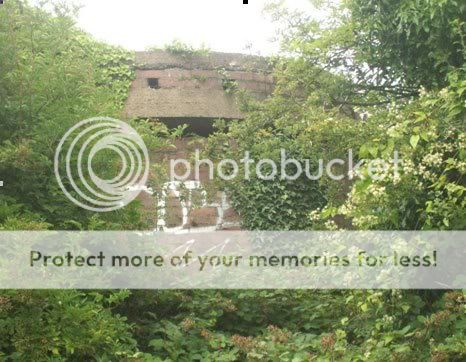
Michael Griffiths, a former Grangetown resident recently sent the Grangetown
Local History Society a photograph of this pill box, off Penarth Road,
asking "is this going to be saved?"
Although Michael lives in Scotland he is a frequent visitor to Grangetown
and to his Grangetown family. The pill box can be found off Stuart Close,
before Penarth Road reaches the link-road fly-over. Michael also remembers
it being used as a bird hide.
Around 28,000 pill boxes were built at strategic points across the UK,
during World War II - sited at places such as road junctions and waterways.
It is estimated that 6,000 still remain today. There's a great website
devoted to the study, record and preservation of
pill boxes as well as a pill
box study group. There don't seem to be any listed for our part of
south Wales, apart from at the old aircraft base at Llandow in the Vale,
so the society is going to contact them.
THE BIRTH OF SOUTH CLIVE STREET
By Jack Payne To facilitate the move we used a handcart hired from the Gas Works, the type
used for carting coke. All the furniture we owned was piled onto this handcart.
For the first few weeks of living there we slept on the bare floor boards. At
that time along the whole length of the street houses were in various stages
of construction. Some were at the basic foundation stage, others were half built
or completed but awaiting interior decorating whilst about 20 were already occupied.
No. 81 was a three bedroom semi-detached house, the other half - number 83
- was still being completed, with interior doors and the like still to be fitted.
The other side of us, no 79, was still at the first level stage of being built
whilst directly opposite the family of O'Connors - children Billy, Dolly, Eddie,
John and Betty had been in occupation for some months.
Having moved there from living in rooms this was an area of wonderful excitement
for boys of my age and there were many of them. At first there was no watchman
on the site and as Cowboys and Indians were the in thing bows and arrows were
required. The site offered large quantities of wooden laths and string enough
to supply all the boys in Grangetown.
At the same time, as families moved in they helped themselves to sand and cement
to build garden paths for their homes. This soon resulted in a watchman, Eli,
being employed to cover from 5pm until work started the following day. The houses
were being finished at quite a fast rate and families were moving in daily.
No1 the Vernacombes, Graham later played as goalkeeper for Cardiff City; at
2 the Olsens, withson Alfie; No 4 the Buleys,Tom and Leon; 6 Barnets Alan; 8
Fearnley, no children but Charlie helped to run Cardiff Gas Boxing Club. 10
Lovell, Alan, opposite side Kazeras, Blakeys, Imperato, Leonard, Ryan, Shaw,
Preece, Sanders, back odd number side Lucas, Graham, Nicholas, Graham, Grady,
Parfit, Morgan, Parsons, Corner of Beecher Avenue, Bulpins Trevor and Vera,
Balch, other side O'Shea Paul, 63 Attley, (inserted by Emery family:)
65 Emery. "We moved out of South Clive Street in 1950 to 5 Ludlow Close. Uncle
Ned Rodd used his horse and cart to help move us all. My aunt Thelma Adams lived
at 120, with husband Albert and son John." 67 Rodd, 69 James Mavis, 71 Gill,
73 Fearnley Craig , opposite Cornish, Greedy, Perkins Malcolm and Cedric, Coles
Josey, O'Connors referred to above, James, Shelley Sylvia and Maureen, Bevan
Teddy, Stubbs Jean, Pearce Ronald, back on odd side 75 Parry Gordon and Dennis,
77 James, 79 Alloway Sylvia, Dorothy, Pam, Valerie, 81 Payne, 83 Chiplin Gladys,
Irene, Thelma, Sylvia. They had an evacuee named Rene Grinewald during the war.
85 Born, 87 Evans, 89 Swan, 91 Leigh, Maureen, they left and a family named
Hall Raymond and Tom moved in. 93 Young 95 Saunders Dennis, 97 Williams Chrissie,
99 Davis "Curly" 101 Andrews Billy he had six fingers on one hand and Stanley
"Ikey". Opposite side Guppy Graham, Johannison, Roach, Binding Barbara, Bellamy
Celia, Batten, Kennedy and others I cannot at present remember. These were the
first people to take up occupation between 1937 and 1940 many families later
enlarged by having more children.
When all the houses were finished and occupied
early 1939 they built walls all along the fronts of the houses and topped these
walls with a wrought iron fence about 18 inches high. Each house was also provided
with a wrought iron gate to their front path.. The pavement was laid in large
concrete slabs and the area between the pavement and road about five feet in
width was laid with turf. No trees were planted at that time. Soon after the
war started the gates and wrought iron fences were removed as scrap for the
war effort.
As the families moved in and removed the builders rubble from their front gardens, the majority laid the front garden to lawn. Turfs of sea grass were dug from the tide fields. These turfs made a lawn of strong wearing really tough grass. I know it was tough because it was my job to cut it with a pair of shears. No lawn mower in those days.
The depression era of the 20s and 30s spawned a generation of hardened street wise kids in Grangetown. A large number of these were domiciled in South Clive Street already toughed to withstand the shortages and perils of the coming war.
The building of the houses in South Clive
Street began in 1937. Our family then consisting of Mam and Dad, sister Hazel,
eight, two-year-old brother and myself aged five, moving into number 81 in the
spring of 1938.

VE Day celebrations at the top end of South Clive Street in May 1945.
Pic: Jack Payne.
| OF MARL AND MUD - BY THE SEA IN GRANGETOWN
By Jack Payne In order to put this in perspective I
need to describe the location as it was then, because in the post war years
the area has changed dramatically. Bordering on Ferry Road and Channel view
was a large open space of reddish earth called The Marl. As one crossed
the Marl and became nearer to the sea, the Marl changed from a flat area
where baseball matches were played to a series of small hillocks. Just past
Bowles Sand and Gravel Dock the ground dropped away about 10-12ft to
a narrow beach of shells gravel and pebbles about three feet wide. Behind
the beach now was an earth sea wall and towards the sea was a large area
of tide fields, sea grass with numerous gullies one or two feet deep crisscrossing
the whole area. Nearer the river the sea grass changed to an area of mud
with banks dropping down 15-20ft to the bottom of the river at low tide.
Just to the seaward side of Bowles stuck in the mud was the skeleton of
an old schooner, known as “The Old Louisa”. I do not know if this was the
true name of the ship. This was a favoured place to play digging in the
mud around the wreck searching for treasure. At low tide these mud banks
became a place of enjoyment for children. We had many long hot summer days
and the sun baked and cracked the mud so that it resembled a large area
of crazy paving. At the lowest tide a boy of 10 years could stand in the
river with the water just reaching his knees so there was no danger of drowning.
The caked mud would be lifted off exposing the slimy wet mud beneath. This
enabled a slide to be made down to the water with the cracks in the mud
beside the slide giving toe holes to climb back to the top. On a fine day
there may be as many as five or six slides on the go. As the tide became
higher the children retreated to the tide fields. The gullies in the tide
fields filled first with seawater and great attempts were made by children
to build dams in an attempt to stop the flow. Nearer to the beach there
were no gullies and at high tide this was a safe area for small children
to play in the water just covering the sea grass. The beach area was a
place where families lit fires and had picnic. At high tide older boys
crossed the tide fields to the Windsor Slipway Pier. This pier which projected
out over the river had been disused for many years and many of the planks
were missing or rotten. By walking close to the side-rail, you could reach
the end safely. The boys would then jump or dive into the sea and swim the
30-40 yards back to the shore. Once the war started families stopped going
to the tide fields, but older boys continued to frequent the area. Boys'
paperbacks of the day, like Rover or Hotspur always had stories of Germans coming
ashore from submarines or dropping by parachute on the shoreline, so we
thought we had better keep a look out. We went across the tide fields to
the Ordnance Depot, helped ourselves to small spades, water bottles and
water bottle carriers stored just inside the wire fence, went back to the
sea wall and dug a number of small caves from which to keep a look out,
and used the bottles for storing water. Needless to say we didn’t spot any
Germans or submarines. Whilst we were digging the caves we dug up a small
silver cup. There was argument in our gang about nine in all as to who should
have the cup. Billy Andrews the eldest of our gang took the cup home, chopped
it up with an axe and gave us a piece each.
Some 20 years later my youngest brother found a Roman coin not far from
where we dug up the cup.
Between the sea wall and Channel View was a large depression. It extended
from Beecher Avenue to the end of Channel View about 100 yards, it was
about 20 yards wide and 10-15ft deep. It was oval in shape had a pond
at each end. The floor seemed to consist of cinders.
Both ponds, which were not very deep, had newts and as it was a suntrap
the weeds grew to about 5ft high. This was another place where children
came to play and fish for newts. The weeds, which grew here, were of the
very thick stem kind and could be used for making a shelter.
At the end of the war this
depression was used as an infill site for household rubbish. It was then
covered and used as a football pitch. It now has flats built over it. On
the night of the big air raid when the Mansion House opposite the Plymouth
pub was destroyed with a heavy loss of life, a land mine was dropped near
the barrage balloon site at the end of South Clive Street. It severely damaged
the last five or six houses in the street. Stick of bombs also landed on
the tide field near the Pier. The stick of bombs which I believe were intended
for the oil depot, left three large craters in the tide field and filled
with sea water when the first tide came in, making three small lakes. There
was an amusing incident regarding these lakes. My friend Calvin made a canoe
and I went with him to launch it. He decided to try it out first in one
of the craters instead of the river and asked me to get in. I declined,
so he got in and the canoe immediately snapped in the middle and sank. A
railway line ran along the far side of South Clive Street terminating at
the Oil Storage Depot just short of the Penarth subway.
During the war an anti-aircraft gun was towed along this line by a train
and used to fire at enemy aircraft during raids. Although the windows
of the houses were criss-crossed with sticky paper and lead this gun caused
more windows to crack than any bomb or shrapnel!
|
| Shop-keepers, street vendors, bookies
runners and living next door to the fish and chip shop
Thanks to JACK PAYNE for letting
us publish this extract from his unpublished autobiography on growing up
in Grangetown during the Great Depression.
I was born in Pentrebane Street, Grangetown in 1933 during the Depression.
Our family also lived in rooms in Amherst Street, Oakley Street and Clive
Street, before moving to South Clive Street in 1938. Thousands of men
were unemployed, families living in Grangetown were poor and shops in
the area were of a type that catered for people without much money. There were many shops in lower Grange but I will only mention those
I feel were a bit different or had something special about them. Opposite
the Plymouth pub in Holmesdale Street, was Warren's. A dark little shop
with bare wooden floors, and bare wooden counter that sold mainly vinegar
and bread. I think Mrs Warren kept her bread covered in damp cloths to
extend its life. The bread was always damp and had a slight mouldy smell.
The next nearest shop to sell bread was Brutons, three quarters of the
way along Holmesdale Street. Olive Bruton wore her hair in the style of
flapper girls of the 20s. Queues formed outside this shop at 6.45am in
the morning and by the time the shop opened at 8am the queue would be
about 50 yards long. The shop had sold out by 10am.
Going back along Holmesdale Street was Udry’s the first "open all
hours" shop, the only shop to open on Sundays and Bank Holidays.
Thomas’s on the corner of Amherst Street was a newsagent who sold sheet
music of the popular songs of the day. My mother Peggy was a pianist and
played in pubs and clubs all over Cardiff. I was sent to this shop to
buy sheet music. Between Amherst Street and Kent Street was a shop that
sold beef and pork dripping and faggots and peas. You had to take your
own basin. If you were buying faggots and peas you had to have a cloth
to hold the hot basin. This shop also sold large marrow bones, which were
purchased for stew. These bones were the leg bones of oxen, cows or horses
and were served up with the stew. The marrow was extracted by using the
handle of a spoon or a piece of stick.
Opposite Brutons was Tarvers, the only true grocery shop in this area,
and run by a brother and sister. I think they liked their own produce,
as they were the only obese people in Grangetown during the war! There
was also a house in Knole Street, which unlawfully sold herb beer. This
was very alcoholic and cheaper than the beer sold in the pubs. One had
to be careful carrying it home because the pressure inside made the bottles
burst easily or the cork to blow off.
Just beyond the Iron Rooms in Paget Street was Joyce’s Pie shop - this
was the predecessor to Clarke's Pies. I think the pie shop at the beginning
of Clare Road was also Joyce’s, which was eventually taken over by Clarke’s.
In those days if you went into a fish and chip shop and wanted pie and
chips, customers always asked for a "Joyce’s pie."
Next door to The Forge pub was Johnny Wright’s Fish and Chip shop. Johnny
had a nose that looked as if a steam roller had run over it! Opposite
Johnny’s was a stable and we lived in one room next to the stable owned
by Mrs Smithyman. The horses would kick the walls and plaster would fall
off in our room. Next to us was Whitings Fish and Chip shop. As children
we could not afford chips but we could go in and ask for a bag of scrumps.
This was the pieces of batter that fell off the fish. We would be given
this free in a triangular paper bag.
There were many vendors plying their wares around the streets of Grangetown
during this time, and there were some very colourful characters. Most
colourful of all was the flypaper seller who was dressed in top hat and
tails and had sticky flypapers pinned all over his clothes. He carried
a cloth bag with his wares and sang at the top of his voice “those dirty
old flies, I’ll catch them alive those dirty old flies. Come and buy my
flypapers we’ll catch them alive those dirty old flies!"
The rag and bone man had a handcart with jars containing a goldfish hanging
from the handles..He tried to waylay children to go into their house and
bring out some rags for a goldfish. The parents always wanted money for
their rags. Salto Taylor had a horse and flat bottom cart ,carrying large
blocks of salt, four of five foot square, and he used a saw to cut off
salt for his customers. At the back of the cart were barrels of vinegar
sold by the half-pint. He had a dirty old tarpaulin sheet that he used
to cover the salt if it rained.
Miss Cazenave, the milk lady, had a horse and cart with large aluminium
milk churns. Milk was purchased in your own container and a long handled
measure of a half a pint was ladled out of the churns. The milk lady later
progressed to an electric handcart with milk sold in bottles.
The Irish dancers came once or twice a year playing music from bagpipes
and dancing gigs. The men and women wore kilts and the daggers in the
men’s socks fascinated me. There was a man who sold hot bread rolls from
a tricycle with a large insulated box at the front. The rolls were usually
sold in blocks of six, but you could buy two for a halfpenny. There was
Pugsley the newspaperman who walked the street morning and evening shouting
"Echo!"
The man who sold shoelaces and polish carried three suitcases, one in
each hand and one tucked under his arm. His wares cost no more than a
penny or two pence each but he must have made a living from it. The Johnny
Onion man who came from Brittany he had a bicycle laden down with strings
of onions. The fresh fish man who had a handcart with fish covered with
piles of ice.
Sid Lewis was the local bookie at that time - unlawfully taking bets
on horse and dog racing. He had bookies runners standing outside the Plymouth,
The Forge and the Bird in Hand Pubs taking bets. I was often sent with
a piece of paper naming a couple of horses and a bet of 3d x 6d or 6d
x 1/-d - never any more. If Dad had won on every horse he backed I don’t
suppose he would have won more than 10/-d but this would have been a fair
sum in those days. I was not the only child doing this, as we were less
likely to be spotted approaching a runner by plain- clothes police who
were always trying to arrest them.
There was also the one-man band that came along the streets. He played
a flute, had cymbals attached to the inside of both elbows and knees,
and had strings attached from the heels of his shoes to a base drum on
his back.
There was an old lady whom children thought was a witch who walked around
the gutters picking up odds and ends and putting them in her bag. She
wore a black Welsh hat, had long grey hair, a black flowing coat long
black skirt, long laced up boots and had a large alarm clock hanging from
her belt.
Finally there were the local men who having travelled about the city
seeking work in the morning congregated on the Marl in the afternoon to
play Pitch and Toss. This was a game where bets were placed on a number
of coins tossed into the air as to what number came down heads or tails.
As many as 20 to 30 men would take part in these games trying to win a
few shillings. Lookouts were posted along the edge of the marl because
the police often raided the games.
|
| OLD CORNER SHOPS
ZENA MABBS, formerly of Kent Street,
writes about her grandfather's time at Thomas and Evans grocer's at 189
Penarth Road.
My grandfather David Thomas Davies worked in this shop for most of his
life, eventually becoming the manager before he retired. This was the
sort of shop with sawdust on the floor and huge slabs of butter waiting
to be cut into the weight you wanted. Muslin covered the large bacon joints
resting on the counter until they were sliced up on the hand-driven bacon
slicer. Unfortunately, for my grandfather, at one stage in his life he
inadvertently sliced off the little finger of his left hand while operating
this machine. No health and safety rules in those days!
On Saturdays, my mother, my sister and myself would walk up to the shop
from our home in Kent Street to place the weekly grocery order with Grandpa.
There he would be behind the counter, with his long white apron on, his
hands always red with the cold. Everything that was ordered was placed
before us on the counter and then neatly packed in a large, brown paper
bag for the delivery boy to bring to our house later in the day.
At the end of this transaction, my grandfather always gave my sister and I a small bar of Fry's Chocolate Cream. How we looked forward to this treat each week.
Sometimes if the delivery boy did not turn up, Grandpa despite being
the manager, and even when he was over 60, would pack up the cycle with
as many orders as the carrier would hold and take to the road. How the
bicycle remained upright was a miracle.
After serving in the shop every day, Grandpa had to write up the books and this was done in a little sort of cubby-hole at the back of the shop. But Grandpa had many talents, woodwork being one of them. One Christmas, he made a miniature shop for us to play with. It had tiny bottles on the shelves containing small quantities of all the sorts of things he sold in the shop. Needless to say, we ate the contents of all the bottles that contained sweets but left the ones with split noodles.
The shop was J R Roach's post office and ironmonger's from 1899,
then E D Evans', who added a stationer's to the business between 1910
and 1920. Then in 1929 it was P L Doddington Grocers before being known
as Thomas and Evans from 1949 to 1952. They had numerous stores. The shop
is now Yang's Chinese restaurant.
Grangetown Local History Society have published "Old Grangetown Shops and Memories" (2009); a further book is planned for 2011.
|
© Grangetown Community Concern and webmaster